.png)
Physics principles shape our understanding of the universe. They explain how everything works, from tiny particles to massive galaxies.
Physics is the foundation of many technologies we use daily. From smartphones to space travel, physics principles play a role. But what are these principles? Why are they so important? In this blog post, we will explore the core concepts of physics.
We'll break down complex ideas into easy-to-understand terms. Whether you're a student, a curious mind, or just want to know more, this guide will help you grasp the basics. Dive in to discover the fascinating world of physics and its fundamental principles.

Fundamental Forces
Gravity is a force that pulls objects towards each other. It keeps us on the ground. The Earth's gravity is very strong. It makes things fall. Planets orbit the sun due to gravity. Gravity affects everything with mass.
Electromagnetism is a force between electric charges. It includes electricity and magnetism. Electricity powers our homes. Magnets attract metals. They are linked by electromagnetism. This force is very important in technology.
The strong nuclear force holds the nucleus of an atom together. It is very strong. It binds protons and neutrons. This force is vital for atomic structure. Without it, atoms would not exist.
The weak nuclear force causes particles to change. It is important in nuclear reactions. This force helps in the decay of particles. It is weaker than the strong nuclear force. But it is still crucial in physics.
Laws Of Motion
Newton's First Law is also called the Law of Inertia. An object at rest stays at rest. An object in motion stays in motion. This happens unless acted on by an outside force. Think of a ball. It won't move unless you push it.
Newton's Second Law shows how force, mass, and acceleration are connected. The formula is F = ma. Force equals mass times acceleration. If you push a heavy object, it moves slower. Push a light object, it moves faster.
Newton's Third Law says every action has an equal and opposite reaction. If you push on a wall, the wall pushes back. Imagine jumping off a boat. The boat moves back as you jump forward.
Relativity Theory
Special Relativity was introduced by Albert Einstein in 1905. It changed how we see motion and time. It says that the laws of physics are the same for all observers. Light always travels at the same speed. Even if you move fast, light's speed is constant. This theory brought the famous equation E=mc². It shows that energy and mass are related. Small mass can become huge energy.
General Relativity came later, in 1915. It explains gravity differently. Mass bends space and time. This bending causes objects to move. Think of a heavy ball on a stretched sheet. The sheet bends, and smaller balls roll towards it. This is similar to how planets move around the sun.
Space-Time Continuum combines space and time into one idea. Space has three dimensions. Time is the fourth dimension. Together, they form a fabric. Events happen at points in this fabric. This concept helps explain how the universe works. It shows how objects move and interact in space and time.

Credit: melscience.com
Quantum Mechanics
Light and matter can behave like both waves and particles. This is called wave-particle duality. Sometimes, light acts like a wave. Other times, it acts like tiny particles, called photons. Electrons also show this dual nature. Experiments have shown electrons creating patterns like waves. This is surprising because we think of them as particles.
The uncertainty principle is a key idea in quantum mechanics. It says you cannot know the exact position and speed of an object at the same time. Knowing one makes the other less certain. This principle was proposed by Werner Heisenberg. It shows that there are limits to what we can measure. Even with the best tools, some things remain uncertain.
Quantum entanglement is a strange and fascinating concept. When particles become entangled, they stay connected. A change in one affects the other, no matter how far apart they are. This connection happens instantly. Albert Einstein called it "spooky action at a distance." Entanglement is important for quantum computing and communication.
Thermodynamics
The First Law of Thermodynamics says energy cannot be created or destroyed. It can only change forms. For example, food turns into energy in our bodies. This law is also called the Law of Energy Conservation. It helps us understand how energy works.
The Second Law of Thermodynamics states that energy spreads out over time. Heat flows from hot to cold places. This is called entropy. It means everything moves towards disorder. This is why ice melts in a warm room.
The Third Law of Thermodynamics says that as temperature approaches absolute zero, the entropy of a system approaches a constant minimum. Absolute zero is very, very cold. It's the point where particles almost stop moving.
Entropy measures disorder or randomness. High entropy means more disorder. Low entropy means less disorder. In simple terms, a messy room has high entropy. A clean room has low entropy. Entropy is important in understanding thermodynamics.
Electromagnetic Spectrum
Radio waves are the longest in the electromagnetic spectrum. They are used for communication. Radios and televisions use them to send signals. They have low energy. They are safe for people.
Microwaves have shorter waves than radio waves. They heat food quickly. Microwaves are also used in radar technology. They help in weather forecasting. They can pass through clouds, making them useful for satellite communication.
Infrared waves are invisible to our eyes. They are felt as heat. Remote controls use them. They help in night vision cameras. Many animals can see infrared light.
Visible light is the only part we can see. It has seven colors: red, orange, yellow, green, blue, indigo, and violet. Sunlight is the main source. It helps us see the world. Plants need it for photosynthesis.
Ultraviolet light has more energy than visible light. The sun emits UV rays. They can cause sunburn. They are used to kill germs. Too much exposure can harm skin and eyes.
X-rays can pass through the body. Doctors use them to see bones. They help in medical imaging. X-rays can detect hidden objects. They are used in security scanners at airports.
Gamma rays have the highest energy. They come from radioactive materials. They are used to treat cancer. Gamma rays can kill harmful cells. They are also used in sterilizing medical equipment.
Cosmology
The Big Bang Theory explains the start of the universe. It began as a tiny, dense point. This point then expanded rapidly. The universe is still expanding today. Scientists study light from distant stars to learn more.
Dark Matter is a mysterious substance. It does not emit light. But it has mass and affects the movement of galaxies. Scientists think there is more dark matter than visible matter. They use special tools to search for it.
Dark Energy is another mystery. It makes the universe expand faster. Scientists think it is everywhere. They study its effects on galaxies. Understanding dark energy helps us learn about the universe's future.
Black Holes are regions in space. They have very strong gravity. Nothing can escape, not even light. Black holes form when big stars collapse. Scientists study them to understand gravity better.
Particle Physics
The Standard Model explains how the smallest particles interact. It includes quarks and leptons. These are the building blocks of matter. Forces like the strong force and weak force act between them. The model helps us understand the universe better. It’s a key idea in physics.
Elementary particles are the smallest known building blocks. Quarks combine to form protons and neutrons. Leptons include electrons, which orbit atoms. Photons carry light, and gluons hold quarks together. Each particle has an anti-particle. These particles form the universe.
The Higgs Boson gives particles their mass. It was discovered in 2012. This discovery was a major achievement. The Higgs field is everywhere. Particles get mass by interacting with this field. Understanding the Higgs Boson helps us understand mass and gravity better.
Astrophysics
Stars are born in clouds of gas and dust. These clouds are called nebulae. The gas and dust come together. They form a star. This process is called nuclear fusion. The star shines for many years. It uses up its fuel. The star can become a supernova or a white dwarf. A supernova is a big explosion. A white dwarf is a small, dense star.
Galaxies are huge groups of stars. They also have gas and dust. Milky Way is our galaxy. There are many types of galaxies. Some are spiral-shaped. Others are elliptical or irregular. Galaxies can collide with each other. This can create new stars. Galaxies are very far from each other.
Exoplanets are planets outside our solar system. They orbit other stars. Some exoplanets might have life. Scientists use telescopes to find them. Kepler and Hubble are famous telescopes. Exoplanets come in many sizes. Some are like Earth. Others are much bigger. Exoplanets can be hot or cold.
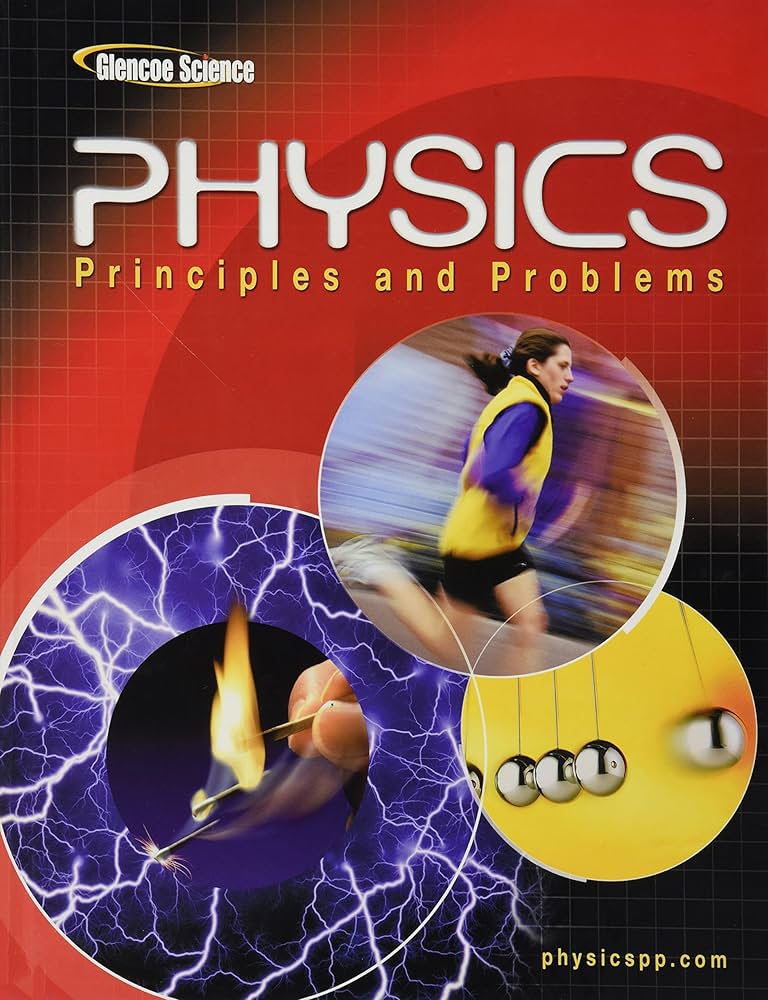
Credit: www.amazon.com
Frequently Asked Questions
What Are The Basic Principles Of Physics?
Physics principles include concepts like force, energy, motion, and gravity. These principles help us understand natural phenomena.
How Does Gravity Work In Physics?
Gravity is a force that attracts two bodies towards each other. It depends on mass and distance.
What Is Newton's First Law?
Newton's First Law states that an object will remain at rest or in uniform motion unless acted upon by a force.
Why Is Energy Conservation Important?
Energy conservation is crucial because it explains how energy is transferred and transformed. It helps in understanding natural processes.
Conclusion
Understanding physics principles helps us appreciate the world around us. These concepts explain everyday phenomena and guide technological advancements. Learning them can be both exciting and rewarding. It opens doors to a deeper comprehension of nature. Keep exploring and nurturing your curiosity.
Physics principles are the foundation of many scientific discoveries. They impact our lives more than we realize. Stay curious and keep learning. Physics is fascinating and endlessly intriguing.





0 Comments