.png)
Physics helps us understand how the world works. It's the study of matter, energy, and their interactions.
Understanding basic physics concepts can be fascinating. They explain everyday phenomena and the laws governing the universe. From gravity pulling us to the ground to why objects float or sink, physics is everywhere. Knowing these principles helps us grasp the mechanics of our surroundings.
This blog will cover fundamental physics ideas, making them easy to understand. Whether you are a student or just curious, these insights will spark your interest in science. Let's explore the wonders of physics together.
Introduction To Basic Physics
Physics helps us understand the world around us. It explains why things move and how they interact. Knowledge of physics can improve technology and solve problems. It also helps us predict natural events like weather. Many inventions come from physics discoveries. From electricity to computers, physics is everywhere.
Physics is used in medicine, engineering, and transportation. Doctors use physics to take X-rays and MRI scans. Engineers design bridges and buildings using physics. Cars and airplanes rely on physics for safety and performance. Even simple things like playing sports involve physics principles. Physics makes our lives easier and safer every day.
Credit: link.springer.com
Newton's Laws Of Motion
A body at rest stays at rest. A body in motion stays in motion. This happens unless acted upon by a force. This is called inertia. It means things keep doing what they are doing.
Force equals mass times acceleration. This law shows how force, mass, and acceleration are related. More force means more acceleration. More mass means less acceleration if force is the same.
For every action, there is an equal and opposite reaction. If you push something, it pushes back. This means forces always come in pairs. Push a wall, and it pushes you back with equal force.
Work, Energy, And Power
Work in physics means moving something with a force. The force must make the object move. No movement means no work is done. For example, pushing a car that does not move means no work.
Energy is the ability to do work. There are different types of energy. The most common are kinetic and potential energy. Kinetic energy is energy in motion. A moving car has kinetic energy. Potential energy is stored energy. A rock on a hill has potential energy.
Power is how fast work is done. It is the rate of doing work. More power means faster work. Power is measured in watts. One watt is one joule per second. To calculate power, divide work by time. For example, lifting a box in two seconds takes more power than lifting it in five seconds.
Concept Of Gravity
Gravity is a force. It pulls objects towards each other. The Earth pulls us down. This is why we don't float away. Gravity acts between all objects. Even small ones. It is important in space. It keeps planets in orbit.
Gravity affects how objects move. Heavier objects feel more pull. Light objects feel less. But both fall at the same speed. This is true in a vacuum. Air can slow things down. A feather falls slower than a rock here.
Isaac Newton discovered universal gravitation. He saw an apple fall. This helped him understand gravity. He said all objects attract each other. The bigger the object, the stronger the pull. The closer they are, the stronger the pull.
Basics Of Thermodynamics
The Laws of Thermodynamics are very important. The First Law says energy can't be created or destroyed. It only changes form. The Second Law says energy moves from hot to cold. This is called entropy. The Third Law says absolute zero is the lowest temperature.
Heat transfer happens in three ways. Conduction is heat moving through solids. Convection is heat moving through liquids or gases. Radiation is heat moving through space. A hot stove is an example of conduction. Boiling water shows convection. The sun warming your face shows radiation.
Energy conversion changes energy from one form to another. For example, a light bulb changes electric energy to light and heat. Cars change chemical energy in fuel to motion. Wind turbines change wind energy to electricity. All machines use energy conversion to work.
Electricity And Magnetism
Electric charge is a property of matter. It can be positive or negative. Like charges repel each other. Opposite charges attract. Electric current is the flow of electric charge. Current flows through conductors like wires. It is measured in amperes (A).
Magnetic fields are created by magnets. They have a north and south pole. Opposite poles attract, like poles repel. Magnetic fields can also be created by electric currents. The Earth has a magnetic field. It helps in navigation.
Electromagnetic induction occurs when a conductor moves through a magnetic field. This movement creates an electric current in the conductor. This is how generators work. They convert mechanical energy into electrical energy. It is used in power plants to produce electricity.
Waves And Sound
Waves move through space and matter. Waves can be big or small. Amplitude is the height of a wave. Frequency is how often the wave passes a point. High frequency waves move faster. Wavelength is the distance between two waves. Long wavelength means the wave is spread out. Speed is how fast the wave travels. Waves can be transverse or longitudinal. Transverse waves move up and down. Longitudinal waves move back and forth. Sound is a longitudinal wave.
Sound moves through air, water, and solids. It needs a medium to travel. In air, sound travels as vibrations. These vibrations make particles move. Particles bump into each other. This creates a sound wave. Sound travels faster in water than in air. It travels fastest in solids. Echoes happen when sound bounces back. Hard surfaces create strong echoes. Soft surfaces absorb sound.
Sonar uses sound waves to find objects underwater. Ultrasound helps doctors see inside the body. Music is made of sound waves. Speakers create sound waves for us to hear. Noise-canceling headphones use sound waves to block noise. Animals use sound waves to communicate. Bats use sound to find food. Submarines use sonar to navigate. Seismologists use sound waves to study earthquakes. They learn about Earth's layers this way.
Light And Optics
Light is a form of energy. It travels in straight lines. Light can travel through space. It is made of tiny particles called photons. Light can behave like a wave. It can bend around objects. This is called diffraction.
Reflection happens when light bounces off a surface. Mirrors reflect light very well. Refraction occurs when light passes through one medium to another. Light bends at the boundary. Glass and water can refract light. This is why objects look bent in water.
Optical instruments use light to form images. Microscopes help us see tiny objects. Telescopes let us see distant stars. Cameras capture pictures using light. Lenses in these tools bend light to focus it.
Modern Physics Concepts
Quantum mechanics is the study of very small particles. These particles are smaller than atoms. At this level, particles behave strangely. They can exist in multiple places at once. This is called superposition. Particles can also be linked together. This is known as entanglement. Quantum mechanics helps us understand the universe on a tiny scale.
Relativity theory was developed by Albert Einstein. It has two parts: special relativity and general relativity. Special relativity deals with objects moving at high speeds. It shows that time slows down for these objects. General relativity explains gravity as a curve in space and time. This theory helps us understand black holes and the expansion of the universe.
Particle physics studies the smallest building blocks of matter. These particles are called elementary particles. The Large Hadron Collider is a huge machine that helps scientists study these particles. Some important particles are quarks, leptons, and bosons. Understanding these particles helps us learn about the forces that shape our universe.
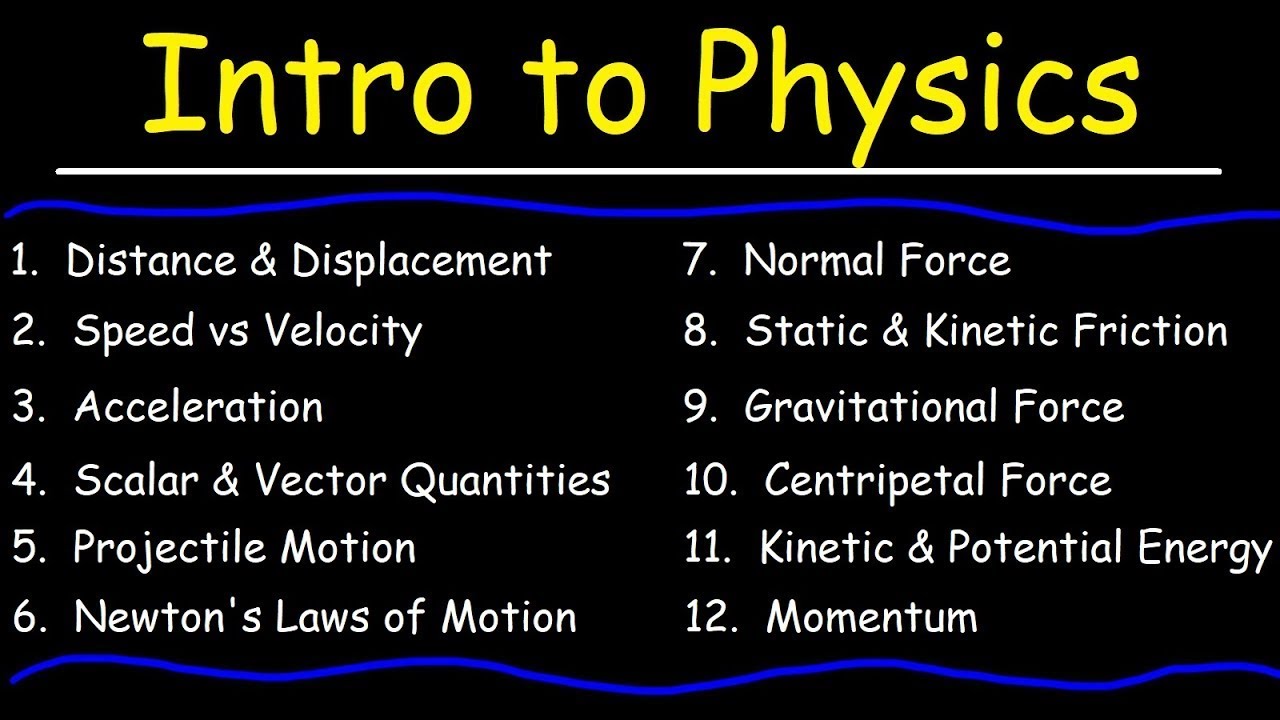
Credit: www.youtube.com
Frequently Asked Questions
What Is Newton's First Law?
Newton's First Law states that an object at rest stays at rest. An object in motion stays in motion unless acted upon by an external force.
How Does Gravity Work?
Gravity is the force that pulls objects toward one another. It keeps planets in orbit around the sun and makes objects fall to the ground.
What Is Kinetic Energy?
Kinetic energy is the energy an object has due to its motion. It depends on the object's mass and velocity.
What Is The Speed Of Light?
The speed of light is approximately 299,792 kilometers per second. It is the fastest speed at which information or matter can travel.
Conclusion
Understanding basic physics concepts is essential for everyday life. These principles explain how things work. They help us solve problems and make informed decisions. From gravity to motion, physics shapes our world. Keep exploring and asking questions. Your curiosity will lead to greater knowledge.
Remember, learning physics can be fun and rewarding. So, stay curious and keep learning.




0 Comments